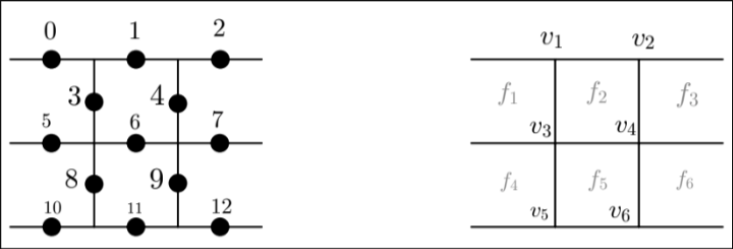
This is the leading candidate for fault-tolerant quantum computers.
1. Stabilizer Operators
Instead of bit-flip noise, we consider general noise combining both (bit-flip) and (phase-flip) errors. Taking superpositions of and errors, we can have arbitrary errors:
Associate the edges of a lattice with qubits,:
Each vertex is given a stabilizer, and each plaquette is given a stabilizer . For example: , . It can be easily shown that and and commute, as do and . Additionally, we can show that and commute. For example:
In general, if and share an even number of qubits, they commute.
Hence, the surface code logical qubit is the eigenspace of the stabilizers and :
2. Code Space & Logical Operators
Logical operators and must (1)commute with the stabilisers (to remain the code space), (2), and (3) be non-trivial (not a product of stabilizers). The solution is not unique:
is the eigenstate of s and . is the eigenstate of and eigenstate of s. This is a highly entangled state.
3. Advantages and Limitations
and commute with stabilizers, so they cannot be detected by a syndrome measurement. This can lead to logical errors (e.g. ).
However, the logical error rate is exponentially suppressed with the code distance (the lattice is ). The code distance is the minimum number of qubits that must be acted on to implement a logical operator. For example, and are both weight operators. Hence, the logical error rate is where is the physical error rate.